
Showing posts with label Caregiver Burnout. Show all posts

Tuesday, November 26, 2013

Assisted Vacation for Family Caregivers and their loved ones

Thomas Stern_AssistedVacation.com


A new type of respite service?

Guest article by Thomas Stern

 
There are few things in life as sweet as the moments before leaving for vacation.
 
The bags are packed, plans have been made, and the anticipation of spending quality time with loved ones makes you feel downright giddy. In older age however, certain health conditions can make vacation impractical or daunting. This was the case in my family.
 
I spent several years caring for two grandparents who had Alzheimer’s disease. Their progression was slow and over time, vacations became more and more infrequent. I went to nursing school to improve my caregiving skills and when their dementia became more severe, they moved into our home.
 
Caring for a loved one, no matter what their health condition, is very personal.
 
As a caregiver, you are the guardian and advocate and nobody can do it as well as you can. Many caregivers find that even if they have the opportunity to take a break, they have trouble relinquishing their caring role.
 
On one of the few vacations that I did take as a caregiver, I spent a week sitting on a tropical beach miserable and worried that my grandparents were not being cared for as well as they deserved. For me, the options for vacation as a caregiver were:
  1. Find a willing family-member or friend to provide care.
  2. Pay a good deal of money to an institution to provide temporary care.
  3. Take my grandparents along on vacation and hope for the best.
I tried #1 and #3, and neither worked out too well.


I learned to differentiate between
the noun of respite and the adjective of respite.
After my grandparents passed away, I worked as the nurse and healthcare coordinator at an Adult Day Service. From the provider’s perspective, I saw how different caregivers experience respite. I learned to differentiate between the noun of respite and the adjective of respite. When caregivers dropped off loved ones to spend the day in our care, they were using a respite (noun) service. However, it was clear to me that many were not experiencing the respite (adjective) that our service intended. Many of our caregivers couldn’t just drop their lives to get a two-hour massage while their loved one was with us because they had jobs, families, chores and too many balls in the air to simply relax for the day. However, I recognized that some of our caregivers were open to allowing the adjective of respite into their day while others always saw their own well-being as secondary or even tertiary.
While working at the Adult Day Service, I began a graduate program in Health Care Management and focused my efforts on solutions for caregiver respite. Early on, it occurred to me that one of the hindrances to caregiver respite was that their loved one was out of their care. However, it was difficult to achieve respite while in the role of caregiver. It was in an attempt to balance these conflicting realities that I developed “Assisted Vacation.”
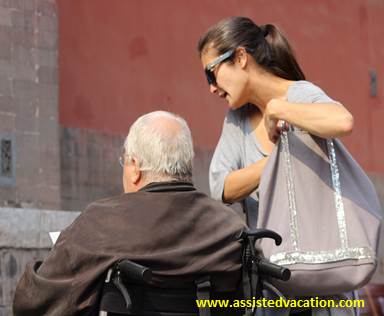
Assisted Vacation

On an Assisted Vacation, a skilled, caring nurse supports a caregiver, their loved one and any additional family members on holiday.

The key to a successful Assisted Vacation is designing the holiday in a person-centered way. Thus, the supporting nurse may be available at the holiday destination to provide a few hours of care each day or the nurse may travel with the caregiver and be available for 24/7 support. Assisted Vacations are crafted to the precise needs of our guests. Over the past several years, I have developed a great team of nurses throughout North America and Europe to provide services to guests to and from nearly any destination.

Like any health or wellness service, there is no one-size-fits-all solution to achieving respite as a family caregiver.

For some, a trip away from their loved one is just the ticket to recharge. Assisted Vacation guests value the service because they want their loved one included on their vacation. They can spend time with their loved one but they have the opportunity each day to step out of the areas of caregiving that are stressful.

We recognize that there is a great need for caregiver respite and we are proud to provide Assisted Vacation to improve the quality of life of our guests.

Thomas Stern founded AssistedVacation.com during graduate school. With a team of excellent nurses throughout North America and Europe, they provide Assisted Vacation services to and from nearly any destination. Thomas and his team can support the unique needs of nearly any family caregiver and their loved ones.

Dementia Signage for the Home


_____________________________

Weekly Planner (Bright Pink) Memo Pad

______________________________

Dementia Signage for the Home

Behavior Triggers Log (Sky Blue) Memo Note PadBathroom Door Sign-Temporary/Reusable Wall Skins


Checklist for Brushing Teeth Wall DecalDaily Pain Journal (Sky Blue) Memo Notepad


EZ-C Bright Green 3 Ring Binder binders


Saturday, October 5, 2013

10 Caregiver Confessions: Secrets We Aren’t Proud Of

Wouldn't it be nice to be perfect? Wouldn't it be nice to be a caregiver who had only loving thoughts every moment of the caregiving day? Maybe there are caregivers like that. If you are one of them, I truly congratulate you. Most of us who have been through years of caregiving will not fall into that category. I don't. How about you?

Here's a sampling of "caregiver confessions" that I've heard. You'll likely feel better just reading them.

Some Non-Angelic Caregiver Thoughts

  1. I have no life of my own and I'm sick of it.
  2. Mom acts like my boss even when it comes to what I eat.
  3. How much longer can I keep this up? There is no light at the end of this tunnel.
  4. Dad has no clue what I give up to do this. He thinks his care is routine.
  5. Everybody wants a piece of me – there's nothing of myself left for me.
  6. I can't even take a bath without someone needing me.
  7. Nothing I do pleases them – they are never happy.
  8. I just want to scream, run away, hide somewhere, or change my identity.
  9. Maybe if I just take all of Mom's sleeping pills I won't have to wake up to this again.
  10. She is suffering so much. She's been half dead for months. Why can't she just let go and die?
Obviously, some of these thought are more serious than others, however what is most important is the frequency of the thoughts and the duration. Let's look at them more closely.

Caregiver Confession #1: "I have no life of my own and I'm sick of it."
Caregivers often run from person to person, job to care receiver, home to nursing home, never really having time to do something that they want to do – just for themselves. If this describes your life, you are over-ready to get outside help. Whether that means some in-home care for respite so you can get away, or a sibling to step in so you don't have to spend every moment of every day as a caregiver, it's time to get a grip on your life. If you don't, you may burn out, get sick yourself, or even die before the care receiver. Who wins then? No one.

Caregiver Confession #2: "Mom acts like my boss even when it comes to what I eat."
Elders in need of constant care feel their own pain. They generally feel a lack of control over their lives, as bit by bit their abilities slip away. This can make some of them disagreeable and bossy. Generally, the answer to this is to learn to detach with love. If she picks on you for eating junk food, just let it go. You need to set some boundaries around what you will respond to. Some things are irritating but really not that important.

Often, if an elderly parent is bossy and critical, it's more about her than you. By detaching – not reacting, but just saying something like, "I'm sorry that's bothering you," and then moving on with what you are doing, you will not be giving in to her nagging. You'll be respectful of her sense of loss, but you won't be a doormat. She will likely get tired of trying to boss you around if you ignore her behavior rather than arguing with her.

Caregiver Confession #3: "How much longer can I keep this up? There is no light at the end of this tunnel."
If you have these thoughts on occasion, you may be just having a normal, down day. Caregiving can be tough and demanding. Caregivers often become exhausted. However, if you find yourself thinking like this often, you should seek medical help. You may have clinical depression, which can require therapy and/or medication (if a break from constant care isn't enough). Please see your doctor.

Caregiver Secrets: What Caregivers Are Really Thinking

Caregiver Confession #4: "Dad has no clue what I give up to do this. He thinks his care is routine."
This is a tricky one. As caregivers, we don't want to make the care receiver feel like he or she is a burden to you. The flip side of that, however, is that sometimes caregivers are so giving and cheerful all the time, that the care receiver completely loses sight of the fact that we give up a lot of our lives to be caregivers.

Also, some care receivers are not cognitively capable of even understanding the concept that the caregiver has other obligations. If you have a constant nagging thought that you are unappreciated, you may be in over your head. Getting some respite care may help. Once the care receiver understands that you need to have a break, he or she may be more appreciative. Either way, if you take a break, you will likely feel more refreshed and able to cope with the situation.

Caregiver Confession #5: "Everybody wants a piece of me – there's nothing of myself left for me."
Nearly every woman has had this feeling, whether it's a new mother with a baby demanding to be fed, changed and nurtured while the boss is sending her emails from work, or a caregiver of elders who still has children who are needy, or a mate who feels neglected
.
In most cases, we get through this, but if it's ongoing, you may need a third party to help you decide what you can give and what others must do. Say you are the primary caregiver for your dad and your mother-in-law. Your spouse is whiny because he/she feels neglected. It may be time to say, "If you help me by picking up some of this extra caregiving, we'll have more time together." This won't always work, but some spouses just don't "get" the teamwork concept unless they are directly approached. If this doesn't work, look for some paid help. You need some time to yourself.

Caregiver Confession #6: "I can't even take a bath without someone needing me."
This is often a literal problem. If you like to relax by taking a half-hour break in the evening to relax in the tub – maybe with candles and music – but are routinely interrupted even during this sacred time for yourself – you are bound to feel some resentment. Expect to have this time interrupted on occasion, but if you never can take time to yourself, please look for some help. Even a Senior Companion from the Retired Senior Volunteer Program (RSVP), or a friend, may be able to sit with your loved one. If that isn't possible, it's time to look for a few hours of in-home help. Everyone needs some peace – even a caregiver.

Caregiver Confession #7: "Nothing I do pleases them – they are never happy."
See number two above. This behavior is often not about you. It's about them and their unhappiness over all of their losses. Do your best to detach from the criticism and get breaks when you can. Not taking criticism seriously is the best way to avoid resentment. Trying to understand why they are so critical can help (I'm not talking about historic family abuse here – just crabby, complaining behavior).

Caregivers' Final Confessions


Caregiver Confession #8: "I just want to scream, run away, hide somewhere, or change my identity."
This is likely to happen to even the most patient caregivers. It's human to feel overwhelmed by the constant neediness of others. It's time to get some help with your caregiving so you can have a break. However, if you feel like this consistently, you should check with your doctor in case you are depressed or have other health issues of your own.

Caregiver Confession #9: "Maybe if I just take all of Mom's sleeping pills I won't have to wake up to this again."
Get thee to a doctor immediately. Even occasional thoughts like this can mean you are clinically depressed and feel life is hopeless. Please get medical help now.

Caregiver Confession #10: "She is suffering so much. She's been half dead for months. Why can't she just let go and die?"
Believe it or not, this is a common thought. You aren't a bad person. Why would you want to watch day in, day out suffering, where the quality of life, such as it is, is poor. Getting hospice care for the individual can help a great deal. Hospice staff counsels family members and they generally have volunteers who can help you. You need breaks, even if the care receiver could die when you are gone. You can't sit by their bed side every minute, for months. There are worse things than death, so drop the guilt. You aren't the only one who has had this thought.

Feel better, now that you know you aren't alone with your thoughts? I'm sure you can add your own "confessions" to this list. You may even think , "Oh, I've thought worse things than this!" If so, share them with caregivers at aSsupport Group. You will quickly see that you aren't alone.

The main point is that having passing "bad thoughts" is normal. You are tired, stressed and pulled in all directions. People are crabby to you and seem ungrateful. It's human to have negative thoughts.
However, if you find yourself consistently thinking in this negative manner, it's time for outside help in the form of respite care for your loved one, breaks for you, or even counseling and/or medication for yourself. You may be depressed. That doesn't mean you are bad. You are just human. It's time to accept your humanity and get help.


 Dementia Signage for the Home

_____________________________

15% OFF ALL ORDERS!

This Weekend!

Use Code: 15FORWEEKEND at Checkout


Weekly Planner (Bright Pink) Memo Pad

______________________________

Dementia Signage for the Home

Behavior Triggers Log (Sky Blue) Memo Note PadBathroom Door Sign-Temporary/Reusable Wall Skins


Checklist for Brushing Teeth Wall DecalDaily Pain Journal (Sky Blue) Memo Notepad


EZ-C Bright Green 3 Ring Binder binders

3.5" x 2" Index Cards (100 pack) business cards


Saturday, July 6, 2013

Yoga for Caregivers: The Natural Way to Relieve Stress & Pain

A couple of years ago, as I jay-jogged across a busy avenue from my parking spot to the building where I worked, I felt a sharp paint shoot up my leg and into my hip. I'd had some nagging pain issues there for a time, but since I have three types of arthritis and am hardly young, this wasn't surprising. Still, it was frustrating.

My mother had undergone double hip replacements and I figured, grudgingly, that my time was nearer than I thought. The hip pain kept getting worse. I found myself wincing as I walked to get the mail. I even developed enough of a limp that my colleagues noticed a change in my normally rapid gait.

I finally made an appointment with a chiropractor I'd seen from time to time. I trusted him, as he knew and respected arthritis issues, and was careful not to do any harm. He manipulated gently and did some acupressure and tapped me in the tight spots with his little rubber hammer. He commented on my tight lower back, not unusual for someone who sits at a keyboard all day.

The treatments helped some, but never lasted. Sometimes, I'd experience numbness the next day. One day, an idea flashed across my little pea brain. "Gee, Honey, you haven't done your yoga routine for, um, 3 years?"

During the mid-70s I received, through a book club, a "free gift" about natural beauty and such. The book wasn't of huge interest to me as I am lazy about such things and still had hippy hair, but I did notice a nice yoga workout. I'd suffered from migraines since my teens, and thought this stretching routine might help the migraines. I've always been unusually limber, so the "workout" seemed effortless. But I did it because it did feel kind of good.


Dementia Signage for the Home

____________________