
Tuesday, November 26, 2013

Assisted Vacation for Family Caregivers and their loved ones

Thomas Stern_AssistedVacation.com


A new type of respite service?

Guest article by Thomas Stern

 
There are few things in life as sweet as the moments before leaving for vacation.
 
The bags are packed, plans have been made, and the anticipation of spending quality time with loved ones makes you feel downright giddy. In older age however, certain health conditions can make vacation impractical or daunting. This was the case in my family.
 
I spent several years caring for two grandparents who had Alzheimer’s disease. Their progression was slow and over time, vacations became more and more infrequent. I went to nursing school to improve my caregiving skills and when their dementia became more severe, they moved into our home.
 
Caring for a loved one, no matter what their health condition, is very personal.
 
As a caregiver, you are the guardian and advocate and nobody can do it as well as you can. Many caregivers find that even if they have the opportunity to take a break, they have trouble relinquishing their caring role.
 
On one of the few vacations that I did take as a caregiver, I spent a week sitting on a tropical beach miserable and worried that my grandparents were not being cared for as well as they deserved. For me, the options for vacation as a caregiver were:
  1. Find a willing family-member or friend to provide care.
  2. Pay a good deal of money to an institution to provide temporary care.
  3. Take my grandparents along on vacation and hope for the best.
I tried #1 and #3, and neither worked out too well.


I learned to differentiate between
the noun of respite and the adjective of respite.
After my grandparents passed away, I worked as the nurse and healthcare coordinator at an Adult Day Service. From the provider’s perspective, I saw how different caregivers experience respite. I learned to differentiate between the noun of respite and the adjective of respite. When caregivers dropped off loved ones to spend the day in our care, they were using a respite (noun) service. However, it was clear to me that many were not experiencing the respite (adjective) that our service intended. Many of our caregivers couldn’t just drop their lives to get a two-hour massage while their loved one was with us because they had jobs, families, chores and too many balls in the air to simply relax for the day. However, I recognized that some of our caregivers were open to allowing the adjective of respite into their day while others always saw their own well-being as secondary or even tertiary.
While working at the Adult Day Service, I began a graduate program in Health Care Management and focused my efforts on solutions for caregiver respite. Early on, it occurred to me that one of the hindrances to caregiver respite was that their loved one was out of their care. However, it was difficult to achieve respite while in the role of caregiver. It was in an attempt to balance these conflicting realities that I developed “Assisted Vacation.”
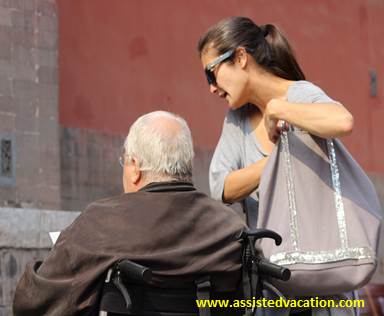
Assisted Vacation

On an Assisted Vacation, a skilled, caring nurse supports a caregiver, their loved one and any additional family members on holiday.

The key to a successful Assisted Vacation is designing the holiday in a person-centered way. Thus, the supporting nurse may be available at the holiday destination to provide a few hours of care each day or the nurse may travel with the caregiver and be available for 24/7 support. Assisted Vacations are crafted to the precise needs of our guests. Over the past several years, I have developed a great team of nurses throughout North America and Europe to provide services to guests to and from nearly any destination.

Like any health or wellness service, there is no one-size-fits-all solution to achieving respite as a family caregiver.

For some, a trip away from their loved one is just the ticket to recharge. Assisted Vacation guests value the service because they want their loved one included on their vacation. They can spend time with their loved one but they have the opportunity each day to step out of the areas of caregiving that are stressful.

We recognize that there is a great need for caregiver respite and we are proud to provide Assisted Vacation to improve the quality of life of our guests.

Thomas Stern founded AssistedVacation.com during graduate school. With a team of excellent nurses throughout North America and Europe, they provide Assisted Vacation services to and from nearly any destination. Thomas and his team can support the unique needs of nearly any family caregiver and their loved ones.

Dementia Signage for the Home


_____________________________

Weekly Planner (Bright Pink) Memo Pad

______________________________

Dementia Signage for the Home

Behavior Triggers Log (Sky Blue) Memo Note PadBathroom Door Sign-Temporary/Reusable Wall Skins


Checklist for Brushing Teeth Wall DecalDaily Pain Journal (Sky Blue) Memo Notepad


EZ-C Bright Green 3 Ring Binder binders


Saturday, November 23, 2013

A Maddening Day With Charlie

Today was one of those "maddening" days with my dementia patient husband. No matter how hard I try to prevent it, it happens once a week.

You see, he still likes to take the trash out.It's always been his job and it is one of the few things he can still do.

The problem is – the recyclables. They only go out EVERY OTHER WEEK!

Charlie keeps a calendar with all of the big events in his life clearly marked, day-by-day. Somehow, he's gotten it into his head that the recyclables go out every 2nd and 4th Wednesday. In spite of every effort I've made to explain to him that every other week is not the same thing, he just doesn't get it.
I even have a card from the disposal company highlighting the weeks that they pick up recyclables. Showing that card to Charlie doesn't help. His brain just can't figure it out. So every week we have an argument about whether or not it is recyclable week.

Then, there was the little problem of a bowel accident today.

I won't go into the details on this one. But I have come to the conclusion that chocolate candies and desserts, other sweets, and gravies are trigger foods that should be avoided at all costs.

Being the stubborn and proud man that he is, Charlie refuses to wear Depends. The phrase "an ounce of prevention" means nothing to him. His brain tells him that if he isn't having a problem on a given day, he doesn't need them. He just doesn't understand that by the time he has a problem, it's too late for the Depends.

Third problem: I've been watching Charlie "swishing" his wine, coffee and juice again.He tells me he swishes to "clean my teeth." The problem with his swishing is that it is causing the enamel on his teeth to deteriorate.

The last time he went to the dentist, the dentist came out to the waiting room and asked me if Charlie was consuming a lot of acidic food. I immediately suspected the swishing and the dentist agreed with me that it was the likely culprit.

My husband knows he has to stop the ridiculous habit but his brain just can't remember!I even placed a glass of water next to his wine glass to use as his swisher—the dentist's idea. But he forgets to drink the water.

Finally, Charlie's late night proclivity: He likes to stay up until eleven or twelve o'clock watching western or war movies. I've seen them all so many times that I prefer to spend an hour or so with HGTV or the Food Network. So I go to my room and leave him with instructions to TURN OUT THE LIGHTS!

Last night I woke up at 2:00 a.m. and realized the lights were still on, and Charlie was fast asleep in bed, AGAIN. Of course, his night owl habits also mean he doesn't get up until nearly lunchtime. This has become a habit that is driving me nuts.

Caring for a dementia patient is like raising a child all over again. The trouble is, as children age they get older and wiser (at least most of them do). As the dementia patient ages, he gets more childlike, eventually regressing to infancy.

There is no stopping the regression. It will happen in spite of all the medications the medical experts come up with; it will happen in spite of everything the caregiver does to keep the patient focused and on track.

We just have to accept it and find our "stress busters" to keep us from also losing our sanity.

Dementia Signage for the Home

_____________________________

Weekly Planner (Bright Pink) Memo Pad

______________________________

Dementia Signage for the Home

Behavior Triggers Log (Sky Blue) Memo Note PadBathroom Door Sign-Temporary/Reusable Wall Skins


Checklist for Brushing Teeth Wall DecalDaily Pain Journal (Sky Blue) Memo Notepad


EZ-C Bright Green 3 Ring Binder binders


What A Holiday Visit Can Reveal About Your Aging Parents

If you're a long distance caregiver, you may be planning a visit to check in on your aging loved ones. This visit is, perhaps, the first opportunity in several months that you'll have to personally observe them.

If you've relied on regular telephone conversations and assessments by other closer-living relatives to gauge their well being, the upcoming holiday visit may be revealing. Absence - even for a short period - often allows us to observe a situation through new eyes. I know, I've been there myself.
I lived 200 miles from my mother who lived alone after my father passed away. Shortly thereafter, mom started showing signs of a decline. To honor her wishes by staying in her own home, I needed to know when it was time to bring in outside help.

I kept a close eye on the following areas during each visit:
Physical Changes
Was she losing or gaining weight? Was she sleeping too much? Was she sleeping too little? How was her balance? Was she walking with any discomfort, or was she unsteady on her feet? (Note: certain medications can cause joint or muscle issues.) When there were concerns, I made sure they were addressed with her primary care doctor. If I noticed any sudden odd behavior, I quickly checked with her doctor to see if it was a urinary tract infection (UTI); very prevalent in elders and easily resolved with antibiotics. (Discover how a urinary tract infection can cause dementia in aging adults)

Emotional Well-Being
I took notice of whether she was still engaged in her normal routines, such as grocery shopping, preparing meals, basic housekeeping, reading the newspaper and personal hygiene. Was she still socially engaged with friends and family? Still going to church on Saturday? Still seeing the hairdresser on Friday? Once there were obvious signs of decline in these daily activities, I knew it was time to seek outside help with a home health aide. Luckily, I was able to get an excellent referral from a relative. (In case you don't know someone who can give you a referral, here are a few tips for how to find the right home health care agency)

Medications
Like many elders, my mother did not like medications. This was very obvious as she had expired and unused prescription bottles strewn throughout the house. This was one of the first areas that I got help with. I started by asking a neighbor to keep an eye on things, then, later I hired a caregiver. On each doctor's visit I obtained an updated medications list and posted a copy on her fridge and in her wallet -- very handy in case of an emergency. (Learn why you should always add identification to an elder's emergency plan)

Home Environment
I took a look to see if and when the bills were getting paid.Once I started finding bills unopened, or tucked between sofa cushions, I knew it was time to step in and help.Since I was already on my mother's checking account and also had Power of Attorney (POA), I had the bills mailed directly to me, ensuring they were all in one place and paid on time.I also paid close attention to the stove being shut off. When mom kept leaving it on, it was time to disconnect it and let the caregiver take over the meal preparation.

Steps to take:
If you see a pattern of decline in your loved one, but you're not sure where to start, I suggest beginning the initial conversation by mentioning what concerns you have, as well as the measures you can take to make things better.
  1. Discuss the idea of a having a health assessment done by your loved one's primary care physician.
  2. Your loved one may need help with housecleaning or bill paying. Ask them how they would feel about having a home health aide visit a couple times a week? I was able to convince my mother of this by reminding her that keeping her healthy and safe would allow her to stay living in her own home.
  3. Maybe you loved one has some legal questions, and would benefit from making an appointment with an attorney – preferably one who specializes in elder law.My mother's attorney was very helpful in so many areas.
  4. Identify resources that can be your eyes and ears when you go back home. This list may include neighbors, family and friends.Make sure everyone on the list has your contact information, in case of an emergency.
  5. Pay a visit to the local Council on Aging or Town Hall to learn more about resources and services available in your loved one's community.
The more systems you have in place, the more your loved one will be kept independent and safe in their own home. This will give you peace of mind as you return home from your holiday.


Dementia Signage for the Home


_____________________________

Weekly Planner (Bright Pink) Memo Pad

_____________


_________________


Dementia Signage for the Home

Behavior Triggers Log (Sky Blue) Memo Note PadBathroom Door Sign-Temporary/Reusable Wall Skins


Checklist for Brushing Teeth Wall DecalDaily Pain Journal (Sky Blue) Memo Notepad


EZ-C Bright Green 3 Ring Binder binders