Showing posts with label Medication Management. Show all posts

Wednesday, April 9, 2014

Dementia and Medication Management

New Service to Prevent People with Dementia from Missing Medications*

 
PillPack_Shipment


Are you a caregiver for a loved one with dementia?
 
Do you fear your loved one is not taking his or her pills correctly?
 
Nearly two-thirds of Americans who take medications report that they are not always taking their medications as prescribed, while only 33 percent say they never miss taking their prescription medications. Not surprisingly about 20% of adverse drug events seen in outpatient care due are to medication errors and 10% of hospital stays are the result of a medication error [1].
 
For people with dementia, it can be particularly hard to stick to a medication routine. Missing medications can make it increasingly difficult getting back on track, with health risks worsening when dementia is present with other conditions, such as a heart condition2. The responsibility often falls on a caregiver to sort bill boxes, order refills, keep records, and attempt to ensure that their loved one is taking the right medications at the right time.

 
PillPack.com

 
PillPack has teamed up with The Caregiver’s Voice to give you a free subscription to their service for as long as you use it. The only thing they ask for is your review after using PillPack’s service for one month (after the second of your two 14-day shipments). PillPack is expanding their service to reach people with dementia, and needs caregivers’ experiences with the sign-up process and transferring and receiving your loved ones’ medications in order to ensure they continue meeting customers’ needs. Your review will be published at The Caregiver’s Voice REVIEW.
 
The Caregiver’s Voice asked Jacqui Miller from the PillPack customer service team, “What if your loved one only takes supplements?” and she explained, “We can source most brand of supplements and include them in your PillPack. We don’t mark them up additionally, so generally the price is the same as at a retail store.
 
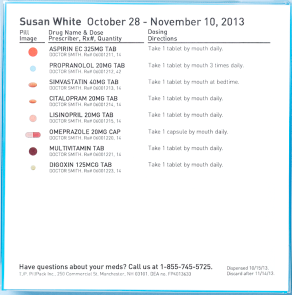
PillPack_Medication_List
If my mother were alive today, I’d sign up for this service so that my father wouldn’t have to sort, split, and package her heart medicines–7 pills 4 times a day. –Brenda Avadian, MA TheCaregiversVoice.com
Click to check out PillPack’s service or click on the right sidebar.
 
Interested in this free benefit in exchange for your experience? Send Brenda Avadian an email.
 
*Although the PillPack program is open to all, The Caregiver’s Voice focuses on caregivers for people with cognitive impairment caused by dementia and seeks a caregiver caring for a loved one with dementia to review PillPack’s service in return for a free membership.
 
[1] “Interventions to Improve Adherence to Self-administered Medications for Chronic Diseases in the United States” Annals of Internal Medicine, Ann Intern Med. 2012 Dec 4;157(11):785-95.
 
[2] “The effect of dementia on medication use and adherence among Medicare beneficiaries with chronic heart failure” American Journal of Geriatric Pharmacotherapy. 2012 Feb;10(1):69-80. doi: 10.1016/j.amjopharm.2011.11.003. Epub 2012 Jan 20.
 

Dementia Signage for the Home


After Shave Labels/ Rectangle StickerBasement Door Sign/ Bumper Stickers


See all our products at Dementia Signage for the Home


Wednesday, November 20, 2013

Care, Prepare, Adapt, and Be Consistent with Medicine

Be Candid and Direct


Use clear, simple language to help your loved one understand the kinds of medications he or she is taking and why. In addition, offer clear instructions such as, "Here's the pill for your high blood pressure. Put it in your mouth and drink some water."

Develop a Routine


Giving medications in a specific way at specific times of the day will help reduce conflicts. Never assume the individual will take medications on his or her own. It may be necessary to check and see whether the medicine has been swallowed.

Adapt to the Person


If your loved one has problems swallowing pills or spits out the pills, ask your physician if the medication is available in some other form, such as a liquid. Some medications can be crushed and mixed with food. However, no pill or tablet should be crushed without first consulting your physician or pharmacist. Crushing some medications may cause them to be ineffective or unsafe.

Get a "Brown Bag Checkup"


As a safety measure, ask to schedule a "brown bag check-up" with your prescribing doctor or pharmacist. Gather all current medications and over- the-counter products into a brown bag and bring them to the doctor or pharmacist so he/she can look for potential problems.

Be Prepared for Emergencies


Research the names and telephone numbers of pharmacies and emergency care centers that are open on the weekends. Keep the number of your local poison control center or emergency room handy. If you suspect a medication overdose, call poison control or 911 immediately.


_________________________

Dementia Signage for the Home


Care Notebook 3 Ring Binder Medication Log Notepad (Sky Blue)


Medication Reminder Notes Notepads Medication Refill Reminder Notepad - Light Blue


Saturday, November 2, 2013

Questions to Ask About Medications

Here is a list of questions for caregivers to ask whenever a doctor prescribes a new medication for their elderly loved one:
  • Why is this medicine prescribed?
  • How does the medicine work in the body?
  • What are the common side effects? What should I pay attention to?
  • Will this medicine interact with other medications—prescription and non-prescription—that my loved one is taking now?
  • When will the medicine begin to work?
  • What should I do if my loved one misses a dose?
  • Should he/she take it with meals?
  • Does he/she need to drink a whole glass of water with it?
  • Are there foods, drugs, or activities he/she should avoid while taking this medicine?
  • Are there any foods or beverages to avoid?
  • Is it safe to drink alcohol while on this medicine?
  • How long will he/she have to take the medicine? Will we need a refill? How do I arrange that?
  • Do you have written information about the medicine that I can take home with me?

Questions to Ask your Doctor About Medications

If the doctor prescribes a drug(s) for your parent's condition, there are some questions you should ask. First, make sure you know the name of the drug and understand why it has been prescribed for your parent. Ask the doctor to write down how often and for how long your parent should take it.

Make notes about any other special instructions. There may be foods or drinks to avoid while your parent is taking the medicine. Or you may have to take the medicine with food or a whole glass of water. If your parent is taking other medications, make sure your doctor knows, so he or she can prevent harmful drug interactions.

Sometimes medicines affect older people differently than younger people. Let the doctor know if the medicine doesn't seem to be working or if it is causing problems. It is best that your parent not to stop taking the medicine on his or her own. If they want to stop taking the medicine, check with your doctor first.

Questions to ask about medications:


  • What are the common side effects? What should I pay attention to?
  • When will the medicine begin to work?
  • What should I do if my parent misses a dose?
  • Should he/she take it at meals or between meals?
  • Does Mom/Dad need to drink a whole glass of water with it?
  • Are there foods, drugs, or activities Mom/Dad should avoid while taking this medicine?
  • Will he/she need a refill? How do I arrange that?
  • Can Mom/Dad become addicted to this drug?


_________________________

Dementia Signage for the Home


Care Notebook 3 Ring Binder Medication Log Notepad (Sky Blue)


Medication Reminder Notes Notepads Medication Refill Reminder Notepad - Light Blue


Reminders Dry Erase Board